Unpacking Texas School Finance: The Recapture Reality
 Justin McKenzie
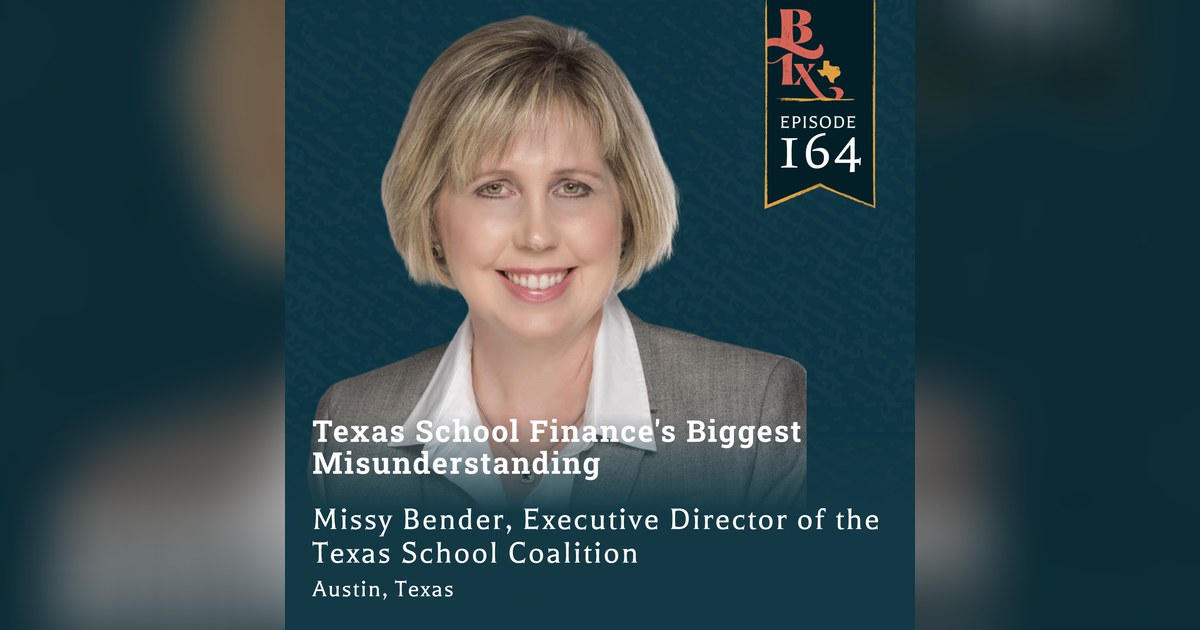
Missy Bender joins The Building Texas Show to demystify the $3 billion recapture program. Contrary to its Robin Hood reputation, recapture primarily generates state savings rather than redistributing wealth from property-rich to property-poor districts.
Found this article helpful?
Share it with your network and spread the knowledge!
TLDRQuick Summary for Different Perspectives
- Understanding Texas school finance myths can give you an edge in navigating policy, especially during election season.
- The podcast explains how recapture works, detailing the impact of property valuation and enrollment on district funding.
- The episode aims to correct misconceptions, potentially leading to fairer school funding and improved state resource allocation.
- Did you know a student's doctor visit can cost a district a full day's state funding even if excused?
Understanding the $3 Billion Recapture Myth
In the latest episode of The Building Texas Show, I had the privilege of sitting down with Missy Bender, Executive Director of the Texas School Coalition. We delved deep into one of Texas's most misunderstood financial mechanisms: the recapture system. Known to some as the 'Robin Hood' program, recapture involves nearly $3 billion being sent back to the state by Texas school districts. However, as Bender elucidates, this process is far from the equitable redistribution many believe it to be.
During our conversation, Bender explained that the reality of recapture is that it generates state savings rather than aiding underfunded districts. The funds contribute to the Foundation School Program, ultimately reducing state financial contributions. This revelation challenges the notion that property-wealthy districts are directly supporting less affluent ones, a misconception that has persisted for far too long.
The Mechanics and Implications of Recapture
Bender and I explored the intricate workings behind recapture, particularly how it impacts districts like Plano ISD. The recapture threshold is triggered by dividing property valuation by average daily attendance, a formula that can result in significant financial strain. Districts with declining enrollment and rising property values experience a 'double whammy,' exacerbating financial challenges. This situation is illustrated by the 2025 top payers, including Austin ISD contributing $770 million and Pecos-Barstow-Toyah at $198 million.
Furthermore, Bender highlighted an often-overlooked aspect of the funding formula: the impact of student absences. A student's absence, even for a doctor's appointment, can result in a full day of lost state funding for a district. Such nuances underline the punitive nature of the current system and the need for a more nuanced approach to funding education.
Reframing the Debate on School Finance
As we navigated through the complexities of recapture, Bender was candid about the program's mischaracterization. She emphasized that the funds redirected by recapture have broader implications, potentially being used for initiatives far removed from education, such as water, transportation, and vouchers. This broad allocation raises questions about the priorities in Texas's educational funding.
Bender also pointed to the findings of Dr. Lori Taylor's funding adequacy study at Texas A&M, criticizing the six-year stagnation of the basic allotment in the face of inflation. Her advocacy extends to legislative efforts aimed at preventing districts from being penalized for excused partial-day absences, a reform that could alleviate unnecessary financial penalties.
As we wrapped up our discussion, it became clear that the conversation around Texas school finance needs to evolve. The recapture program, with all its intricacies, is not the Robin Hood it is often perceived to be. Instead, it serves as a catalyst for a broader dialogue on how we can better support our schools and, by extension, our future generations. I invite you to listen to the full episode and join the conversation on how we can shape a more equitable education system for all Texans.
About Justin McKenzie
Based in Boerne, Texas, Justin also hosts The Building Texas Show—a podcast spotlighting the bold minds shaping the future of the Lone Star State. When he’s not building teams or building momentum, he’s out exploring, discovering new ideas, or connecting with the people who make it all worthwhile.