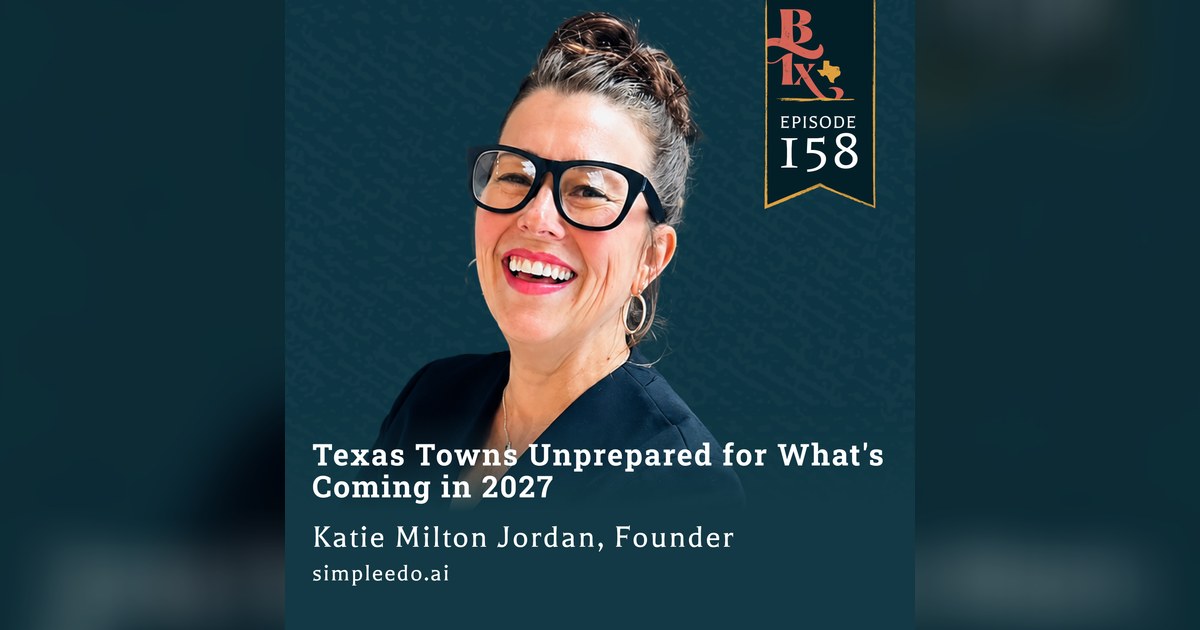
Navigating the Intelligence Farming Revolution in Rural Texas
 Justin McKenzie
As the dawn of 'intelligence farming' approaches in 2027, rural Texas communities face significant challenges. The latest episode of The Building Texas Show delves into the preparedness of these areas, revealing an urgent need for adaptive strategies and regional collaboration.
Found this article helpful?
Share it with your network and spread the knowledge!
TLDRQuick Summary for Different Perspectives
- Rural Texas leaders can leverage AI for strategic advantages in 'intelligence farming,' leveling the playing field with better-resourced areas.
- SimpleEDO.ai synthesizes public records with AI to reveal historical constituent signals, aiding unprepared rural leaders in strategic planning.
- AI democratizes access to economic strategies, empowering under-resourced communities and enhancing public sector workflows in rural Texas.
- The Building Texas Show explores the future of 'intelligence farming' and the role of AI in transforming rural economies.
Exploring the Intelligence Farming Landscape
In a recent episode of The Building Texas Show, I had the opportunity to engage in a dynamic conversation with Katie Milton-Jordan, the visionary founder and CEO of SimpleEDO.ai. Our dialogue unfolded in the picturesque setting of Mason, Texas, where we delved into the upcoming wave of 'intelligence farming' anticipated in 2027. It's a topic that carries profound implications for rural Texas communities and their preparedness—or lack thereof—for the transformations ahead.
The episode highlighted a compelling claim from a global consortium of AI transformation experts: 2027 is poised to be a watershed year for what they term 'intelligence farming.' This shift will pose significant demands on local governments, particularly in rural areas that may not be fully equipped to meet these challenges. Throughout our discussion, Milton-Jordan and I traversed several key themes, illuminating the gaps that volunteer mayors and lean city councils face compared to the well-prepared site selectors they must contend with.
Bridging Knowledge Gaps and Enhancing Collaboration
One of the most striking elements of our conversation centered on the concept of 'context mining.' Milton-Jordan eloquently described how sifting through town hall records and board meeting archives can unearth invaluable constituent signals, providing a clearer picture of community needs and aspirations. However, the reliance on 'tribal knowledge' within municipalities and small economic development organizations (EDOs) often hampers progress, underscoring the importance of regional collaboration.
The discussion naturally gravitated towards the need for collaborative efforts across the Texas Hill Country, challenging the traditional silos defined by county lines. This approach, Milton-Jordan argues, can empower these communities to harness AI as a democratizing force, offering access to strategies previously reserved for larger, more affluent areas. Her vision is one where AI serves as a leveling tool, equipping even the most under-resourced communities with the means to thrive in this new era.
Charting a Path Forward with AI
The conversation took a deeper dive into the tangible impact of AI on public-sector workflows, particularly in regard to optimizing for both revenue and risk. As data centers increasingly find a home in rural America, their site-selection metrics reveal glaring information gaps that local leaders must address. Milton-Jordan's practical solution involves synthesizing years of public-record minutes, surveys, and board cadences with AI to illuminate historical constituent signals, thereby making informed decisions.
Moreover, our dialogue also provided a glimpse into the upcoming Hill Country Venture Fest, slated for October 1 through thetownie.ai. This event promises to build on previous successes, such as the Kerrville-area Venture Fest, which spotlighted innovators like Miles Murray, a Tyvee graduate with groundbreaking contributions in energy and biofuels.
As I reflect on this enlightening episode, it becomes apparent that the road ahead for rural Texas mayors and civic leaders is fraught with both challenges and opportunities. The imperative to embrace AI and foster regional collaboration is clear. By doing so, these communities can not only meet the demands of the intelligence farming revolution but also position themselves as pioneers of innovation in the Lone Star State. With each conversation on The Building Texas Show, I am reminded of the resilience and creativity that define Texas—and the people who are shaping its future.
About Justin McKenzie
Based in Boerne, Texas, Justin also hosts The Building Texas Show—a podcast spotlighting the bold minds shaping the future of the Lone Star State. When he’s not building teams or building momentum, he’s out exploring, discovering new ideas, or connecting with the people who make it all worthwhile.