Bridging the Gap: How Website Structure Influences AI Search Visibility
 David McInnis
In an era where AI-driven search platforms like ChatGPT and Google SGE are redefining the digital landscape, InLinks unveils a groundbreaking study uncovering 19,000 structural gaps across 5,000 websites. This analysis not only highlights the critical role of site architecture in enhancing brand visibility but also offers a strategic roadmap for organizations aiming to secure a competitive edge.
Found this article helpful?
Share it with your network and spread the knowledge!
TLDRQuick Summary for Different Perspectives
- InLinks' findings can guide businesses to outperform competitors in AI search rankings by addressing common website structural gaps.
- InLinks conducted a study on 5,000 websites, identifying structural gaps affecting AI search performance and offering a framework for improvement.
- The research highlights the importance of comprehensive, well-structured websites for enhancing brand visibility and user experience in the AI-driven search landscape.
- A major accounting software provider boosted its AI search presence for 'e-invoicing' by 650% with better internal linking, showcasing practical benefits.
Unveiling Hidden Website Gaps
In the digital age, the quest for visibility on search engines has transcended beyond traditional SEO strategies, urging companies to navigate the complex terrain of AI-powered search platforms. InLinks, a pioneering force behind the AI Brand Visibility platform Waikay.io, has embarked on an ambitious journey to dissect the anatomy of 5,000 websites, unveiling 19,000 distinct gaps that significantly diminish brand visibility across both conventional and AI-driven search engines. This meticulous structural analysis, spotlighting the intricate relationship between site architecture and AI search performance, marks a momentous stride towards understanding the nuances of digital visibility in the current era.
The Criticality of Structural Integrity in the AI Search Era
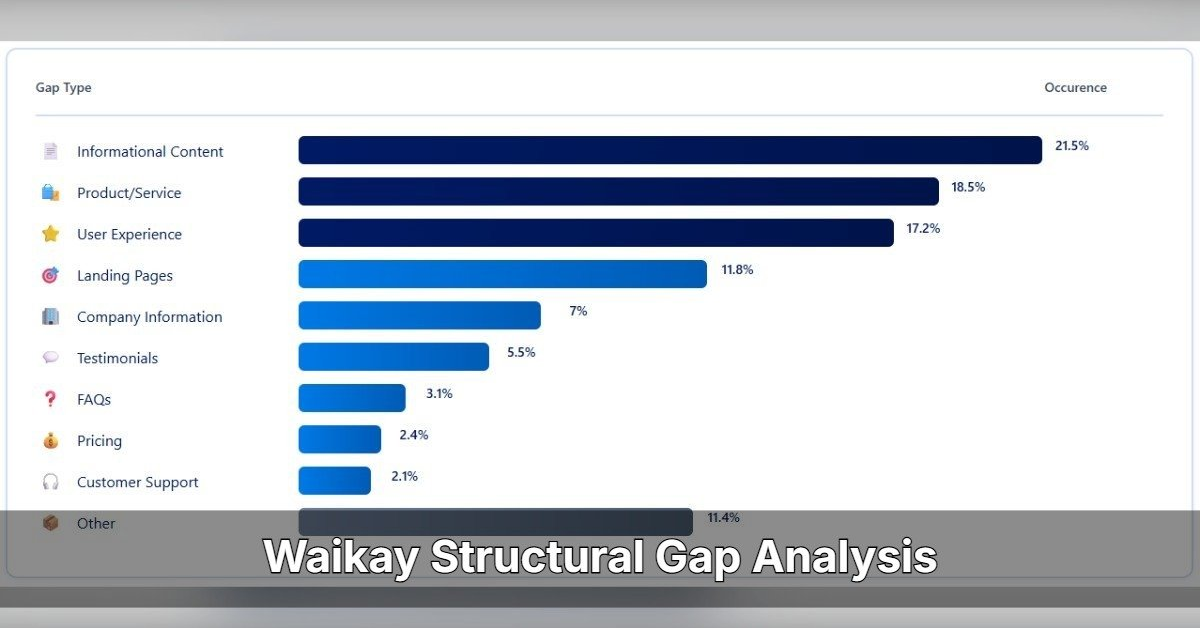
With the advent of AI search technologies such as ChatGPT and Google SGE, the digital marketing landscape confronts a new paradigm. These platforms, by leveraging entity associations and comprehensive content coverage, demand a more structured and interconnected web of information from websites. The analysis by InLinks reveals that a staggering 57% of the identified gaps can be categorized into three pivotal areas: missing informational content, absent product or service pages, and UX or structural deficiencies. Dixon Jones, CEO of InLinks, underscores the urgency of addressing these gaps, emphasizing that a website's failure to communicate its scope, audience, and content interconnections can severely undermine its AI search visibility.
The findings further elucidate that the single largest category of gaps pertains to missing informational content, which accounts for 21.5%. This highlights the absence of educational and explanatory pages that AI engines rely on to establish topical authority. Additionally, UX and structural deficiencies, comprising 17.2%, impede a site's crawlability and internal linking, thus restricting its ability to signal content relationships—a crucial element for AI entity recognition.
Strategic Remediation and Demonstrated Success
The severity and prioritization of these gaps vary significantly across industries, suggesting that a one-size-fits-all approach to remediation is impractical. However, InLinks' research not only identifies these structural shortcomings but also provides a beacon of hope through demonstrated results and a replicable framework for improvement. A notable case involves a major accounting software provider, which, by strategically enhancing internal linking, amplified its AI entity associations for 'e-invoicing' by an astonishing 650%. InLinks itself has validated the efficacy of the hub-and-cluster content methodology, climbing from the 6th to the 1st rank for a target category in AI recommendation rankings.
The comprehensive report, made available at https://waikay.io/action-plans/seo-structural-gap-analysis/, offers an in-depth exploration of the gap taxonomy and a prioritization framework, equipping organizations with the tools to navigate the complexities of AI search optimization. This analysis, rooted in the Waikay.io platform's structured taxonomy of gap types and observations of AI engine behavior patterns, sets a new standard in the pursuit of digital excellence.
In conclusion, the groundbreaking study by InLinks serves as a clarion call to businesses navigating the digital frontier. It emphasizes the imperative of structural integrity and interconnectedness in a website's architecture as foundational to achieving prominence in the AI-driven search landscape. With a strategic approach to remediation, organizations can transcend the barriers of traditional SEO, unlocking new dimensions of brand visibility and competitive advantage.
About David McInnis
David McInnis is the Founder of Newsworthy.ai, a news marketing platform that helps organizations amplify their stories and reach wider audiences. Previously, he founded PRWeb, where he transformed the newswire industry by pioneering distribution strategies in the era of Search. Today, David is once again at the forefront of innovation—this time rewriting the rules for how AI reshapes the news experience.